Overview of the Fifth Circuit’s Decision

The United States Court of Appeals for the Fifth Circuit (“Fifth Circuit”) handed certain partners in limited partnerships within its jurisdiction a huge win regarding self-employment tax. In Sirius Solutions, L.L.L.P. v. Commissioner,[1] a divided Court of Appeals held that a limited partner for purposes of the self-employment tax exception under Internal Revenue Code (“IRC” or “Code”) Section 1402(a)(13) means a partner in a limited partnership with limited liability, i.e., a limited partner under state law. In so holding, the Fifth Circuit rejected the Tax Court’s application of the Renkemeyer[2] “functional analysis test” and the government’s arguments that “limited partner” only refers to “passive investors” in a limited partnership.

The Code imposes a tax on “self-employment income,” which is defined as “the net earnings from self-employment.”[3] The tax is imposed on self-employed individuals, including individuals that are partners in a partnership. However, IRC Section 1402(a)(13) excludes the distributive share of income of a “limited partner, as such,” from the net earnings from self-employment (the “1402(a)(13) exception”). The term “limited partner” is not defined in the statute. As expected, the Social Security law also contains an identical exception for purposes of computing Social Security benefits to maintain symmetry between the taxes an individual pays and the benefits an individual is entitled to receive.[4]

Background of the Sirius Solutions Dispute

Based on the 1402(a)(13) exception, Sirius Solutions L.L.L.P., a Delaware limited liability limited partnership, excluded its limited partners’ distributive share of partnership income from its calculation of net earnings from self-employment for the 2014 through 2016 tax years. On audit, the Internal Revenue Service (“IRS”) determined that Sirius Solutions’ state law limited partners did not qualify as limited partners for purposes of the 1402(a)(13) exception because the exception only applies to passive investors.

Sirius Solutions contested the IRS’s determination and asserted that the meaning of the term “limited partner, as such” meant a limited partner under state law with limited liability. Relying on its decision in Soroban Capital Partners, LP v. Commissioner,[5] the United States Tax Court held that “limited partner, as such,” for purposes of the 1402(a)(13) exception, only refers to passive investors. Sirius Solutions appealed.

The Fifth Circuit’s Textual Analysis

Judge Oldham, writing for the majority, began by reviewing the statute’s text and dictionary definitions of “limited partner” to ascertain the ordinary meaning of the term “limited partner” at the time the statute was enacted. These 1977-era definitions convinced the majority that the “touchstone” for the term “limited partner” was limited liability.[6] The majority also held that the words “as such” following “limited partner” did not detract from that meaning but were intended to clarify how individuals who serve as both a limited and general partner are to be taxed. In addition, the majority noted that if Congress wished to only exclude passive investors from the tax, it could have easily written the exception to do so, just as it had used the term “passive investor” in other provisions of the Code.

Agency Interpretations Support Limited Liability Meaning

The majority opinion then turned to interpretations of “limited partner” by two federal agencies—the Social Security Administration (“SSA”) and the IRS. With respect to the agency determinations, the court found that the IRS and SSA have “contemporaneous, longstanding, and consistent” interpretations of the term “limited partner,” including in the IRS’s instructions to its Form 1065, U.S. Return of Partnership Income, as well as the SSA’s rules related to the identical exception for computing Social Security benefits, to mean a partner with limited liability in a limited partnership. Together with the dictionary definitions, the majority held that the term’s “single, best meaning” is a partner in a limited partnership that has limited liability.

The court further explained that it is not the taxpayer’s label as “limited partner” that allows the taxpayer to qualify for the 1402(a)(13) exception but rather the substantive interests created under state law. Thus, a taxpayer in the “hypothetical State of West Carolina” labeled as a “limited partner” under state law even though he or she was a sole proprietor, would not be considered a “limited partner” for purposes of IRC Section 1402(a)(13); however, a taxpayer in the “hypothetical State of East Carolina” labeled as “schlimited bartner” under state law but nonetheless a member of a limited partnership with limited liability, would qualify for the 1402(a)(13) exception.[7]

Role of State Law in Federal Tax Interpretation

In response to the IRS’s assertions that federal law, not state law, controls the interpretation of federal tax statutes and that federal tax law should be interpreted uniformly nationwide, the majority noted that to determine the federal meaning of “limited partner” necessarily requires a review of state law to determine if the preconditions of the federal statutory definition are satisfied, because “limited partnerships are creatures of state law, not federal law.”[8]

Scope of the Decision

It should also be noted that in a footnote, the majority limited the scope of its decision to membership in a limited partnership, stating that its discussion did not extend to members of another entity such as a limited liability partnership or a limited liability company.[9]

Having so ruled, the Fifth Circuit vacated and remanded the case for further proceedings consistent with the opinion, holding that a “limited partner” under the 1402(a)(13) exception “is a limited partner in a state-law limited partnership that is afforded limited liability.”[10]

Implications and Practical Considerations

The implications of the Fifth’s Circuit’s decision in Sirius Solutions are unclear and it is likely the government will appeal the decision. At present, two cases with the same issue, Soroban Capital Partners LP v. Commissioner[11] (Second Circuit), and Denham Capital Management LP v. Commissioner[12] (First Circuit), are currently pending in other United States Circuit Courts of Appeals. Another case, Point72 Asset Management LP v. Commissioner[13] (Second Circuit) is currently pending before the Tax Court. If the event a circuit split occurs, a significant amount of uncertainty could arise absent action by Congress or the United States Supreme Court.

In light of this decision, taxpayers who are partners in a limited partnership with limited liability within the Fifth Circuit (states such as Texas and Louisiana) fall into the 1402(a)(13) exception and their distributive shares of income are excluded from the net earnings from self-employment, and thus from self-employment tax liability. As long as a partner retains their status as a limited partner under state law, it does not matter how active that partner is in the business of the partnership or how many services the partner performs for the partnership to be eligible for the 1402(a)(13) exception, which may lower the self-employment tax liability of any limited partner that included their distributive share in their net earnings from self-employment.

It is possible the Fifth’s Circuit’s decision in Sirius Solutions could correspondingly result in a reduction in Social Security benefits of any person residing in the Fifth Circuit who paid self-employment tax on their self-employment income from a limited partnership as a result of the identical exception in 42 U.S.C. 411(a)(12), which would seemingly result in the removal of a limited partners’ self-employment income from the benefits calculation. It is not clear if or when such a reduction would occur or how significant such a reduction would be given that the Fifth Circuit’s decision is restricted to limited partnerships and limited liability limited partnerships at present. Thus, any person residing in the Fifth Circuit that remitted self-employment tax on their distributive share from a limited partnership should consider whether it is appropriate to file protective refund claims for all open tax years.

In addition, a resident taxpayer that is a limited partner in a limited partnership should consider their filing options going forward, e.g., whether to pay the self-employment tax and file a protective refund claim, thereby mitigating interest risk but losing the potential returns on the funds used to pay the tax for a period of time, or whether to not pay self-employment tax on their distributive share from a limited partnership and accept the risk of additional liability in the event Congress or the Supreme Court overturns Sirius Solutions.


For additional information, please contact: Jaye Calhoun at (504) 293-5936, Willie Kolarik at (225) 382-3441, Divya Jeswant at (504) 293-5766, Kevin Baker at (713) 844-3007, or Derek Brondum at (337) 422-3667.

Jaye Calhoun, Willie Kolarik, Divya Jeswant, Kevin Baker, and Derek Brondum are members of Kean Miller’s Tax group, which advises a variety of clients on federal, state and local tax (SALT), and estate planning matters. The team works collaboratively to develop practical, multidisciplinary strategies that anticipate issues, minimize risk, and resolve complex tax issues efficiently, whether through negotiations or formal litigation proceedings.


[1] Sirius Solutions, L.L.L.P. v. Commissioner, No. 24-60240, slip op. (5th Cir. Jan. 16, 2026).

[2] Renkemeyer, Campbell & Weaver v. Commissioner, 136 T.C. 137 (2011).

[3] IRC §§ 1401(a), 1402(b).

[4] 42 U.S.C. 411(a)(12).

[5] Soroban Capital Partners LP v. Commissioner, 161 T.C. 310 (2023).

[6] Sirius Solutions, L.L.L.P. v. Commissioner, No. 24-60240, slip op. at 7 (5th Cir. Jan. 16, 2026).

[7] Id. at 17.

[8] Id. at 16-17.

[9] Id. at 5.

[10] Id. at 24.

[11] Soroban Capital Partners LP v. Commissioner; (T.C. Memo. 2025-52).

[12] Denham Capital Management LP v. Commissioner (T.C. Memo. 2024-114).

[13] Point72 Asset Management, L.P. v. Commissioner (T.C. Docket No. 12752-23).

“Where did this puddle come from?” is a simple question. However, the failure of a plaintiff to answer this question may result in dismissal of a case under the United States Court of Appeals for the Fifth Circuit’s recent opinion in Howard v. Brookshire Grocery Company.

On November 6, 2025, the Fifth Circuit affirmed a district court’s granting of a motion for summary judgment on grounds that the plaintiff failed to show a store operator either created the puddle or had actual or constructive notice of the puddle.[1]

Case Background

Lily Howard (“Plaintiff”) was shopping at a Super 1 Foods Store operated by Brookshire Grocery Company (“Brookshire”) in Lafayette, Louisiana when she fell on a mixture of water and ice.[2] Plaintiff brought a slip-and-fall claim under the Louisiana Merchants Liability Act, which requires proof of three (3) elements:

  1. the condition presented an unreasonable risk of harm, and that risk of harm was reasonably foreseeable;
  2. the merchant either created or had actual or constructive notice of the risk; and
  3. the merchant failed to exercise reasonable care.[3]

The appellate court agreed with the district court’s determination that the Plaintiff failed to show Brookshire either created or had actual or constructive notice of the puddle.

Evidence Considered by the Court

Approximately 19 minutes before the Plaintiff fell, two Brookshire employees were stocking frozen products into freezers in the exact area of the fall.[4] The cart holding the products sat over the area for nearly 9 minutes before the employees finished and left the area.[5]

However, Brookshire employees testified that ice does not accumulate on the products that were being unloaded, although there was no dispute that water was present on the floor at the time of Plaintiff’s fall.[6]

Majority Opinion vs. Dissent

The dissenting opinion by Judge Graves reasoned that, based on the surveillance video, the condition either existed for over an hour and numerous employees failed to remedy the condition or was created by the employees unloading frozen products.[7] The majority, disagreeing, noted that these inferences amounted to mere speculation or suggestion regarding the timing of the puddle’s appearance, which is insufficient to meet the burden under the applicable law.[8]

The court’s holding in Howard distinguishes the Plaintiff’s case from cases where the merchant failed to act to remedy a known risk,[9] the size and nature of a spill indicated that the spill was present for some time,[10] and the merchant failed to ensure its floors were safe.[11]

Practical Takeaways for Defendants

The Howard opinion provides favorable jurisprudence for defending against merchant liability claims. Ask the plaintiff, “where did this puddle come from?”

If the case is about a smear or a slick unknown substance, you should extrapolate from this case and ask, “where did this smear come from?” or “where did this substance come from?”

And, if the plaintiff cannot answer the question, then a defendant should move for dismissal.


Randy Cangelosi and Will Mathews are members of Kean Miller’s Casualty and Mass Tort Litigation group in the firm’s Baton Rouge office, where they manage complex litigation dockets and try cases for some of the nation’s leading companies. They defend clients at the local, regional, and national levels in a broad range of matters, including wrongful death, personal injury, industrial accidents, chemical exposure, products liability, medical malpractice, workers’ compensation and disability claims, as well as breach-of-contract and other business disputes.


[1] Howard v. Brookshire Grocery Co., No. 23-30448, 2025 WL 3111596 (5th Cir. Nov. 6, 2025).

[2] Id. at *1.

[3] La. R.S. § 9:2800.6(B); Miller v. Michaels Stores, Inc., 98 F.4th 211, 216 (5th Cir. 2024).

[4] Howard, 2025 WL 3111596,at *1.

[5] Id.

[6] Id.

[7] Id. at *10–14.

[8] Id. at *10 (citing Bagley v. Albertsons, Inc., 492 F.3d 328, 330 (5th Cir. 2007) (quoting Allen v. Wal-Mart Stores, Inc., 37,352 (La. App. 2d Cir. 6/25/03), 850 So.2d 895, 898–99)).

[9] Id. at *6–7 (citing Deshotel v. Wal-Mart La., L.L.C., 850 F.3d 742 (5th Cir. 2017)).

[10] Id. at *9–10 (citing Bagley, 492 F.3d 328; Henry v. Wal-Mart Stores, Inc., 99-1630 (La. App. 3 Cir. 3/1/00), 758 So.2d 327, 329).

[11] Id, at *7–8 (citing Savoie v. S.W. La. Hosp. Assoc., 2003-982 (La. App. 3 Cir. 2/25/04), 866 So.2d 1078).

In a premises liability case, determining whether prior accidents occurring on a defendant’s premises are admissible can be a challenge for defendants. The “substantial similarity” requirement for prior accident admissibility helps Louisiana defendants to prevent prejudicial evidence from coming before the jury.

Clarifying the Standard for Prior Accident Evidence

Louisiana courts follow a three-part test for prior accident admissibility as summarized in Davis v. Louisiana Power & Light Co.: “to be relevant the other accident should occur at substantially the same place and under substantially the same conditions and must be caused by the same or similar defect, danger, act or omission.”[1] In this case a painter was electrocuted and injured when his aluminum ladder came into contact with an uninsulated power line. The court rejected prior accident evidence where accidents occurred at different locations with different electrical line configurations, even though both involved ladder contact with power lines.

Plaintiff argued on appeal that the trial court erred in disallowing evidence of prior accidents involving contact between aluminum ladders and overhead power lines. The Louisiana Fourth Circuit held in reply that evidence of prior accidents is admissible for the limited purpose of showing that a thing or place was dangerous, and the defendant knew of the dangerous condition. However, the prior accidents must be closely related in circumstance to the injury or hazard at issue.[2]

How Louisiana Courts Apply the Substantial Similarity Test

The court further held that these prior accidents were distinguishable because:

  1. First, the prior accidents did not occur at the apartment complex at issue, but rather at another nearby complex;
  2. Second, the workers injured in the prior accidents were conducting a variety of activities unrelated to painting, such as air conditioning repair and roofing; and
  3. Finally, the configuration of the lines at the apartment complex where the accident occurred was different than the complex where the prior accidents occurred.

Because the line configurations at the two apartment complexes were substantially different, the Fourth Circuit held that the prior accidents did not put the defendant on notice of an unreasonable risk of harm at the apartment complex where the accident occurred.[3]

This demonstrates that mere topical similarity is insufficient without substantial identity of circumstances.

Why the Requirement Matters

The substantial similarity requirement helps to prevent prejudicial evidence from reaching juries. As the Davis court explained, “Louisiana jurisprudence establishes that the admissibility of evidence of prior accidents is confined to those involving substantial identity of circumstance because of the risk of prejudice associated with informing a jury of other accidents.”[4]


Ambrose Stearns is a member of Kean Miller’s Offshore Energy & Marine group and practices in the firm’s Lafayette office. He advises a wide range of clients, particularly Louisiana-based and multistate energy companies, through every stage of development and across diverse legal needs. Ambrose’s experience includes general business and transactional counsel, regulatory guidance, entity formation, and the preparation of employment agreements, commercial contracts, partnering arrangements, and service agreements.


[1] Davis v. Louisiana Power & Light Co., 612 So.2d 235 (1992).

[2] Id. at 239.

[3] Id.

[4] Id. at 235.

In the wake of a recent and markedly successful U.S.-China trade mission, the Office of the United States Trade Representative (“USTR”) has issued a formal notice suspending the actions and sanctions previously levied under Section 301 of the Trade Act. The USTR – at the direction of President Trump – first announced the proposed suspension on November 6, 2025, following the White House’s November 1, 2025 proclamation of a historic trade deal having been reached between President Trump and China President Xi Jinping. The Office of the USTR also issued a Request for Comments on Suspending Section 301 Action for One Year: China’s Targeting of the Maritime, Logistics, and Shipbuilding Sectors for Dominance. The comment period – while uncharacteristically brief – applied only to the USTR’s November 6, 2025 notice. The majority of those comments supported the proposal to suspend the trade action. The USTR has extended comments to its October 16, 2025 notice through November 12, 2025.

The impetus behind the trade and economic deal struck between the world’s two-largest-economic powers emanated from a strong desire to safeguard U.S. economic strength and national security. To bolster those concepts China has agreed to help stop the outward flow of substances used in fentanyl production, eliminate export controls on rare earth elements and select critical minerals, end retaliation against certain U.S. manufacturers and semiconductor producers, and expand its purchasing market to U.S. agricultural products, particularly soybeans. The U.S. will in turn lower tariffs on Chinese imports – although a 10% is expected to remain in place during the suspension, extend the expiration of certain Section 301 tariff exclusions, and suspend implementation of other trade sanctions.

The noticed suspension went into effect on November 10, 2025 and shall likely stay in place for one year, or until end of day November 9, 2026, unless the USTR deems further actions appropriate in advance of the suspension deadline. The suspension period will be marked by a cessation on fees for maritime transport services under Annexes I, II, or III of the April 23, 2025 notice, as modified by the October 16, 2025 notice, which pertain to Chinese-operated, Chinese-owned, and foreign-origin car carriers, respectively. Additionally, neither the U.S. nor China will accrue any liability for duties, which would otherwise be levied under Annex V. A of the October notice. The penalty pause comes as a welcomed relief to those operators, ports, and transportation professionals and entities subject to financial setback due to the mutual-retaliatory trade policies. The respite from fees and tariffs may also allow the U.S. to enhance its efforts to strengthen domestic trade policy and work with select vendors and contractors to revitalize, reimagine, and reform the U.S. Shipbuilding industry, while welcoming foreign economic participation and investment from trusted partners.

Will the temporary suspension serve to lower global shipping costs and offset the impact of commercial-supply-chain disruption? Will it allow the current administration time to identify creative solutions to attract investment into American-built ships? Will it mitigate the higher prices and negative impact experienced by domestic industry sectors heavily reliant on international trade? And what will the fee and penalty schedule look like at the conclusion of the suspension? Opportunities for enhanced trade and supply-chain modifications abound. For more information concerning answers to these and other international trade and trade-finance queries, please contact international trade, supply-chain, and trade-finance professional, Stephen Hanemann, at stephen.hanemann@keanmiller.com.


Stephen Hanemann guides some of the world’s most advanced and sophisticated companies through leveraging their trade, finance, and logistics-related challenges and opportunities. Stephen believes in real-time, practical legal solutions for clients engaged in admiralty and maritime operations, intermodal and multi-modal shipment; project and asset-acquisition finance; import-export and customs regulation compliance.

With a few notable exceptions the City of New Orleans residential Short-Term Rental (STR) regulations[1] enacted by City Council in March 2023 and in 2024 were largely upheld in September and October 2025, in separate decisions by the United States Court of Appeal for the Fifth Circuit and the United States District Court for the Eastern District of Louisiana.

The Fifth Circuit made it plain from the start in its October 7, 2025, decision that “the City has the authority under state law to regulate STRs.” The Court noted that “STR ordinances plainly fall within the City’s broad authority to regulate the ‘use of [a] . . . residence’ for short-term rentals, which are defined temporally by the length of a guest’s stay.”[2] The Court considered the constitutional challenges to the regulations and concluded that:

  • Business entities are entitled to obtain an STR owner or operator permit as prohibiting them violates the Equal Protection Clause;
  • The City of New Orleans cannot restrict STR advertisements to only one dwelling unit because such restrictions violate the First Amendment;
  • Out-of-state residents may obtain an STR operator permit and act as STR operators as long as they are present on the premises and available during stays by STR guests, so as not to violate the dormant Commerce Clause.

History of Residential STR Regulations in New Orleans

Over the past nine years the regulation of residential STRs in the City of New Orleans has been on a roller coaster ride. Beginning in 2017, the City first offered STR licenses with few requirements on license holders. After a reevaluation of STRs by the City Planning Commission, the City Council enacted sharper limits in 2019 intended to protect the character of New Orleans neighborhoods, limit noise and trash nuisances, and preserve affordable housing stock. This ordinance restricted STR licenses to owners who lived in the home as their primary residence and prohibited STR license-holders from “(1) advertising illegal STRs and (2) advertising legal STRs with greater capacities than permitted by their licenses.”[3] The 2023 ordinance then revised the residency requirement so that license holders did not have to own the home; limited residential licenses to one per square city block to be awarded by lottery[4], included the requirement that the licensed operator live on the premises, limited property owners to only one STR license, and increased penalties for violations.[5] In 2024 the City enacted regulations on third-party STR platforms like Airbnb, VRBO, and others doing business in New Orleans requiring them to “verify that its host-users possess a valid STR permit . . . before collecting a booking fee” and mandated that the STR platforms give the City monthly reports with details on transactions and properties in compliance with the law.[6]

Recent STR Regulatory Disputes

Property owners and Airbnb, Inc. sued the City of New Orleans in February 2025 seeking to have the residential STR regulations dismissed on state and federal constitutional grounds. Judge Jay C. Zainey of the United States District Court for the Eastern District of Louisiana dismissed 10 out of the 11 claims. The Judge upheld the plaintiffs’ Fourth Amendment challenge finding that the 2024 Ordinance’s requirement that Airbnb submit monthly reports of its business records is unreasonable because there is no opportunity for Airbnb to “contest the administrative search by the City before a neutral officer” prior to being penalized for not complying.[7]

Special Exception Process Ended

The City Planning Commission issued a Notice on October 9, 2025, officially discontinuing the “special exception process” that had provided a bit of an escape valve to the one-per-square-block limit on STRs. The 2023 Ordinance had allowed a process whereby a second or even third property owner had the chance to obtain an STR license by going through a process that involved seeking neighborhood support and then approval by the respective City Councilmember. This was changed in September 2024 when the City Council prohibited the review of any special exception applications submitted after September 19, 2024.[8] A total of 373 applications were received prior to the deadline and 267 were complete and able to be processed.

Current STR Status

The result of all the ups and downs with the residential STR regulation is an active market in New Orleans with 1,358 licensed NSTRs as of February 2025 plus 1,134 licensed CSTRs. According to the Transient Lodging Study commissioned by the City Planning Commission there were over 7,500 noncompliant STRs as of March 2025.[9] This has decreased by 88% as of August 2025. All current NSTR licensees, as well as licensed bed and breakfasts, and neighborhood zones where transient housing is prohibited are posted online for anyone to see.[10] Hotels and Bed and Breakfasts are permitted to obtain an XSTR license to be allowed to list their transient lodging on rental platforms like Airbnb.

Transient Lodging

Since June 8, 2023, there has been a moratorium on new Commercial Short Term Rentals (CSTRs) in New Orleans pending a study on the impact that underregulated CSTRs have had on the housing market, local economy, and quality of life. In advance of the expected expiration on November 5, 2025, the City Council adopted a unanimous motion directing the City Planning Commission to hold a public hearing on a new Interim Zoning District (IZD) that would require the approval of a conditional use by ordinance for any hotel/motel, hostel, commercial short term rental, timeshare, or bed and breakfast where such are currently permitted uses in the Comprehensive Zoning Ordinance.[11]

The Transient Lodging Study prepared for the City Planning Commission has taken longer than expected and is now set for public hearing on December 9, 2025.[12] This Study addresses banning whole-home or whole-building CSTRs and limits on the number of CSTR units per building. The Study addresses CSTRs and all other transient lodging including hotels, motels, timeshares, hostels, and bed and breakfasts, including:

  • Limitation on number of rooms and guests, by unit
  • Other density limitations, which may vary by zoning district, zoning district classification, future land use designation or other such land use designation
  • Number of permits allowed per owner and/or operator
  • Requirement that each permit holder is a natural person, not a juridical person
  • Strengthened requirements, including density limitations and other standards, for transient lodging uses that (1) abut residential or mixed-use zoning districts, and/or (2) are located in a building that also houses long term residents, so as to mitigate quality of life impacts
  • A requirement for transient lodging uses to be located on the same lot, parcel, or building as other commercial uses
  • Possible use of transient lodging allowances to incentivize the development and/or preservation of affordable and/or workforce housing
  • In buildings with units used for both long term and short-term housing, requiring separate entrances to access short term dwelling units
  • Requiring other standards for entry, including keypads
  • Requiring on-site operators
  • Requiring a 24/7 staffed front-desk in a publicly accessible space
  • Overall impact of CSTRs and other transient lodging uses on the availability of long-term housing – affordable, workplace, and market-rate — and possible measures to mitigate such impacts, including but not limited to an overall cap on person or permits who may participate in the CSTR and other transient lodging markets, and increasing the price of a CSTR owner and/or operator permits.
  • Establishing and/or modifying use standards for transient lodging uses as may be necessary, including for hotel/motel.
  • Closing loopholes that allow buildings operating as hotels, other transient lodging uses or long-term residences to allocate 100 percents of units to CSTR use.

The recommendations in the Study include extensive updates to the Comprehensive Zoning Ordinance to restrict transient lodging in various ways including adding size classifications based on number of bedrooms to scale transient lodging to neighborhoods and mandating that management be on call 24/7 to respond to complaints at larger lodgings. We are closely monitoring the upcoming CSTR hearings before the City Council and will provide updates.


Molly Vigour brings her experience in business licensing, entity formation, lease extensions and disputes, and land use issues to the firm’s New Orleans office.


[1] Residential Short-Term Rentals in New Orleans are officially known as Non-Commercial Short Term Rentals (NSTRs) while STRs in commercial zones are CSTRs. Short Term Rental Administration – Announcements – Short Term Rental Update – City of New Orleans

[2] Hignell-Stark v. City of New Orleans, 154 F. 4th 345, 352 (U.S. Ct of App. 5th Cir. Oct. 7, 2025) (citing La. Rev. Stat. § 33:4721 and Deslonde v. St. Tammany Parish, 391 So. 3d 706, 716 (La. App. 1st Cir. 2024)). The out-of-state Hignell-Starkproperty owners originally sued the City on constitutional grounds challenging the City’s 2019 STR regulations after their STR licenses were not renewed. Id.  

[3] Hignell-Stark v. City of New Orleans, 46 F. 4th 317, 321 (U.S. Ct of App. 5th Cir. 2022) (citing NEW CODE § 26-618(b)(1) – (4)) (Hignell-Stark I).

[4] The first lottery was conducted in City Council Chambers on August 14, 2023, where an actual bingo ball cage was used to choose the winner on contested blocks. Visit Short-Term Rental Lottery 8/14/23 to see for yourself.

[5] Bret Bodin, et al. vs. City of New Orleans, Case 2:25-cv-00329, U.S. Dist. Court Eastern Dist. La., filed Sept. 8, 2025 (Appeal filed by Bret Bodin, et al. Sept. 17, 2025).

[6] Id. at 6 (citing NEW CODE § 26-622).

[7] Id. at 42.

[8] The Non-Commercial Short-Term Rental Special Exception Interim Zoning District was established by City Council Motion No. M-24-493.

[9] Microsoft Word – 2025.10.28 Final Report Draft at pages 6, 10 of Report. Microsoft PowerPoint – NOLA-10.28-DRAFT-CPCBriefV2 at slides 6 – 8.

[10] Non-Commercial Short Term Rental License Map

[11] M-25-530-(SUBSTITUTE-MOTION).pdf

[12] City Planning – Topics – Major Studies & Projects – Transient Lodging Study – City of New Orleans

In Louisiana, even a name on the product may no longer help a plaintiff climb to the apparent manufacturer level according to Pellecer v. Werner.

The Louisiana Supreme Court’s October 24, 2025 decision under the Louisiana Products Liability Act (“LPLA”) redefines the doctrine of apparent manufacturer. Traditionally, when a product bears a company’s name — and nothing suggests otherwise — that label serves as a kind of Jacob’s Ladder for plaintiffs: a symbolic and evidentiary bridge from appearance to liability.

But in this case, the Court pulled that ladder away. The justices held that a name alone — even one long associated with the product — is not enough to establish apparent manufacturer liability unless the company has affirmatively done something with or to the product itself.

The Facts: A Ladder, a Label, and Three Werners

The case involved an alleged defective ladder upon which a user was fatally injured. The ladder bore the “Werner” name, a brand nearly synonymous with ladders. But the entities sued — Werner Holding Co., Inc. and Werner Co. (Delaware) — were not the same Werner that had actually manufactured the ladder. The original manufacturer, Werner Co. (Pennsylvania), had gone bankrupt and changed its name to Old Werner.

The new Werner entities had acquired some of Old Werner’s assets, keeping the Werner trademark specifically because of the brand name recognition. When the plaintiffs brought suit under the LPLA against Old Werner and Werner Co. (Delaware) and Werner Holding Co., Inc., they argued as to Werner Co. (Delaware) and Werner Holding Co., Inc. that, because the ladder’s label said “Werner” and there was no contrary information (no marketing or other consumer information put out by them to disassociate them from the Werner name), the defendants had “held themselves out” as the manufacturer.

A jury agreed, awarding a verdict of $5,036,012 and assigning 50% of the fault to Werner Co. (Delaware) and Werner Holding Co., Inc., jointly. The trial court affirmed the jury verdict, having denied the defendants’ motion for judgment notwithstanding the verdict. The court of appeal affirmed, deferring to the jury’s finding that the label created a reasonable public perception of who made the product was not manifestly erroneous and that a “fair interpretation of the evidence” was in support of the jury verdict.

The Supreme Court Reverses: No Ascent Without Action

The Louisiana Supreme Court, however, stopped this climb cold. It reversed the jury’s verdict, holding that the mere appearance of a company’s name on a product — without more — is not enough to make that company an apparent manufacturer under La. R.S. 9:2800.53(1)(a).

The Court emphasized that liability requires affirmative engagement with the product — a real-world connection beyond the label, with the following sound bites:

“Nothing establishes that defendants ‘put out’ or held out as their own the ladder.”

“When a defendant holds itself out as a manufacturer, it necessarily includes a level of engagement in the process of manufacturing or distributing the product, or a level of control or influence over the subject product.”

“One must do something to or with the product that affects it in a meaningful way.”

In short: No Action = No Ascent.

Without evidence that the defendants designed, built, sold, or controlled the ladder, the Court found no basis to hold them liable, despite the label and despite consumer perception.

From Penn v. Inferno to Werner: The Ladder Splits

The Court’s reasoning initially highlighted the pre-LPLA decision in Penn v. Inferno Manufacturing Corp.  — where an exploding sight glass bore only the defendant’s label, and the court found apparent manufacturer liability because “an observer would not know that anyone other than” the defendant had made it.  Without further comment to show why the LPLA’s apparent manufacturer should not sound in this concept in a case with very similar facts, the Court declined to climb that same path. It instead tightened the doctrine: a company must actually “do something” with the product, not just lend its name to it.

That shift transforms the apparent manufacturer doctrine from one of public appearance to one of corporate action. It is apparent that apparently was not enough to the Werner court.

The Jury’s Ladder — Kicked Away

Perhaps the most striking part of the decision lies not in its statutory interpretation, but in its stance toward the jury. Louisiana appellate courts ordinarily give great deference to jury verdicts, especially where issues of appearance, labeling, and perception are at stake — all matters that jurors are uniquely positioned to assess. The court of appeal followed that tradition, affirming the verdict as supported by reasonable inferences.

The Supreme Court, however, citing its “right and obligation to determine whether a trial court verdict is clearly wrong based on the evidence…” concluded that the jury’s findings were not after all supported by any “legal or factual” basis. This is particularly intriguing considering the prior case law on apparent manufacturer liability emphasizing liability attaches to the apparent manufacturer “when viewed from the perspective of the purchasing public,” a question that most naturally lends itself more to a fact determination.

The Court basically set the Penn v. Inferno doctrine up in flames.  Leaving that doctrine based around what the public sees, the Court made room for more rungs on the ladder for the product liability plaintiff to climb beyond just labels and perception. “Actions” sufficient to assign apparent manufacturer liability means more than just use of the name.

The Dissent: The Label Still Counts

Justice Hughes dissented, warning that the majority had “moved the rungs” of the apparent manufacturer ladder in response to a relatively large jury verdict. He argued that retaining the “Werner” name after acquiring Old Werner’s assets was itself a form of holding out — a deliberate branding choice that signaled continuity. For him, that act satisfied the statute, and the jury’s verdict should have remained intact. The majority’s new “do something” requirement, he posited, added words that the legislature never wrote — and erased a jury’s finding that fit the common sense meaning of “apparent manufacturer.”

Practical Implications: How Manufacturers and Insurers Should Read the Rungs

For manufacturers, insurers, and product liability counsel, Werner offers both clarity and caution:

  • Brand ≠ Control. A familiar label or trademark on a product is not enough to make its owner a manufacturer under the LPLA.
  • Control Is the Key Rung. Liability now requires affirmative control or influence over the product’s design, manufacture, or distribution.
  • Acquisition Clarity Matters. Asset purchase agreements should clearly limit successor obligations and define how legacy branding will be used.
  • Insurance Exposure Narrows. Policies and risk assessments can better distinguish between branding rights and manufacturing activity.
  • Expect More Summary Judgments. Courts will likely decide apparent manufacturer claims as a matter of law, not fact, unless plaintiffs can show tangible involvement with the product.

Conclusion: The Ladder Stops Short

For years, a company’s label on a product was the plaintiff’s Jacob’s Ladder — a symbolic ascent from appearance to accountability. The name on the product provided the path upward, connecting perception to liability.

But in Werner, the Louisiana Supreme Court set the final rungs up in flames. A label, no matter how prominent, is no longer a bridge to the courthouse. To reach the top — to impose apparent manufacturer liability — plaintiffs must now show not only whose name is on the ladder, but whose hands were on it.

In Louisiana, at least for now, the label is just a label — and the climb stops there.


Adrien Busekist and Randy Cangelosi are members of Kean Miller’s Products Liability Litigation group, representing Fortune 1000 manufacturing, industrial, energy, technology, petrochemical, and food service clients in liability litigation involving mass disaster or individual incidents with machinery, safety equipment, tools, and various industrial and consumer products.

Effective October 15, 2025, the Governor of Louisiana surprised many by issuing Executive Order No. JML 25-119 (“EO 25-119”), which establishes a moratorium directing the Department of Conservation and Energy (“Department”) to “suspend review of any new Class VI applications to construct that are submitted to it after” October 15, 2025. Relatedly, the Department issued guidance dated September 1, 2025 (Guidance No. B-2025-01) and October 13, 2025 (Guidance No. B-2025-01-A) which may affect pending Class VI permits. It is evident that that EO 25-119 was driven in part by increasing public concern over the last few years. However, for now, the State appears to have continued its general support for CCS, as EO 25-119 acknowledges:

(i) the immense economic opportunity CCS affords Louisiana;

(ii) the fact that Louisiana is at the forefront of CCS projects in the United States; and

(iii) the growing impact of public or local opposition to CCS.

Introduction and Policy Statements

At a high level, we note that this moratorium on new Class VI permit applications is effective immediately and has an unspecified duration. We expect additional guidance to be provided in the coming months. Citizens and outside interest groups applauding this “moratorium” would be well-served to read the entire Executive Order, which includes numerous statements and directives supportive of CCS in its preamble as follows:

WHEREAS, Louisiana’s extensive industrial infrastructure – including pipelines, liquefied natural gas (“LNG”) facilities, a highly skilled energy workforce, and expansive port system, is in conformity with President Trump’s policies, and it uniquely positions the State as a national leader in CO2 capture and storage, capable of seamlessly integrating CO2 capture into existing processes, enhancing America’s energy competitiveness globally;

WHEREAS, Louisiana, for over 40 years, has injected CO2 into the geological formations of our state for the use of enhanced oil recovery (“EOR”) in projects;

WHEREAS, CO2 has been safely transported via pipelines across Louisiana since 1986;

WHEREAS, Louisiana’s unparalleled capability to produce, transport, process, utilize, and liquefy natural gas while simultaneously sequestering CO2 entirely within its borders, and its position on the Gulf of America, makes the state indispensable to the pursuit of energy dominance, fostering strategic reliance from European and Asian markets seeking dependable, large-scale carbon-neutral feedstocks, thereby solidifying Louisiana’s role at the forefront of global energy leadership and economic competitiveness;

WHEREAS, CO2 capture and storage will extend Louisiana’s presence in energy by creating 17,000 potential new jobs, investing seventy-six billion dollars in potential capital for communities throughout Louisiana from announced projects alone, and driving economic growth on a scale unimaginable for Louisiana;

WHEREAS, CO2 capture and storage will provide additional revenue sources for local governments, has the potential to create a more diversified economy for Louisiana, and continue to serve as a catalyst for multiple industries, while sustaining and enhancing existing industries.

A drastic measure such as a moratorium appears disconnected from the Executive Order’s statements that Louisiana is uniquely positioned as “a national leader in CO2 capture and storage,” CCS plays a key role in “solidifying Louisiana role at the forefront of global energy leadership,” and highlighting the growth potential associated with CCS – “driving economic growth on a scale unimaginable for Louisiana.” However, at the end of its preamble, EO 25-119 tellingly references recent state legislation mandating notice, hearings and input with respect to local governments and concludes that, “local government and citizens, through their local government, have a right to be heard to ensure safety, transparency, and local input.” Thus, it is apparent that politics has thrust itself into what is primarily a regulatory permitting process.

Response from Trade and Industry Associations

Push back from groups such as Louisiana Mid-Continent Oil & Gas Association (LMOGA), the Louisiana Oil & Gas Association (LOGA), the Louisiana Association of Business and Industry (LABI), and the Louisiana Chemical Association (LCA) has been swift and unified in opposition to the moratorium. As an exemplar, the Louisiana Chemical Association issued public “Comments” on October 15, 2025, which succinctly highlight the concern at this critical juncture for CCS-related projects and investment:

[A] conditional moratorium on new Class VI permit applications, as announced today, sends the wrong message to the market at a pivotal moment for Louisiana’s economy. Carbon capture and storage (CCS) is a critical part of maintaining and growing the manufacturing industry in our state. A pause on applications, regardless of the reasoning, signals uncertainty for projects that enable lower-emissions production, support thousands of high-wage jobs, and encourage future reinvestment.

Louisiana earned federal approval to run its own Class VI program so that permitting could be rigorous, predictable, and efficient here at home. That hard-won primacy, and the state’s recent issuance of its first Class VI permit, demonstrate that Louisiana can safely develop these projects in a way that protects communities and natural resources while continuing to encourage industrial investment in the state. A moratorium undermines that predictability at the very time companies are making multi-billion-dollar, multi-decade siting decisions.

Beyond the Moratorium

EO 25-119 also provides a high-level synopsis of existing federal and state regulations for Class VI injection wells, as well as highlighting proposed federal rules for CO2 pipelines by the federal Pipeline and Hazardous Materials Safety Administration (“PHMSA”). Importantly, the Executive Order seeks to:

(i) more fully incorporate Louisiana Economic Development (“LED”) into the decision-making process, including “projected economic impact including local and regional economic growth, workforce opportunities, and any community benefit plan adopted by parish governments;” and

(ii) “provide a clear roadmap for citizens and local officials.”

With respect to “Pipeline Safety Integration,” Section 5 of EO 25-119 interestingly provides that, “all operators shall adhere to the existing requirements found at LAC 33:V (Hazardous Wastes and Hazardous Materials) and any forthcoming federal CO2 pipeline safety standards currently under PHMSA rulemaking (PHMSA– 2022–0125);” and “require[s] equivalent protective measures, including remote or automatic shut-off valves, robust emergency planning, and corrosion-control protocols.”

Although previously filed Class VI permits are not subject to the moratorium, if they are not one of six (6) projects selected for prioritization (listed below and inclusive of the Class VI Permit issued for Hackberry Sequestration), they will not be prioritized until compliance with Sections 4 and 6-10 of EO 25-119 is achieved and will likely face delays. While most of these referenced Sections incorporate or emphasize pre-existing Class VI application standards (such as “Emergency Operations Plan,” “Well Control procedures,” a “Plugging and Abandonment Plan”), there is some new guidance, particularly regarding public engagement, financial assurance and survey plats (to include “associated pipelines”), and consultation with LED for “Class VI permits with potential for significant economic impact.” Relatedly, Guidance No. B-2025 applies to review of existing Class VI Permit applications and sets forth required public engagement plan requirements and activities, including that the Department “give substantial consideration to local government comments on Class VI projects…” Importantly, this Guidance also addresses “major modifications,” and provides that unsolicited major modifications or alterations by applicants (as described further therein) will cause the Class VI permit application to be “reassigned to the end of the technical review queue.”

As referenced above, EO 25-119 also directs the Department “to reevaluate the status of applications for assessment and prioritization for the Class VI permits” as set forth in Guidance No. B-2025-01, which interestingly provides that the “Class VI review team will concentrate on the following permit applications following the issuance of the permit for Hackberry Sequestration in Cameron Parish (listed in alphabetical order):

(1) Capio Sherburne CCS Well #1 (Pointe Coupee Parish);

(2) CCS 2 – Wilcox2 (Vernon Parish);

(3) Goose Lake and Minerva South (Calcasieu and Cameron Parishes);

(4) LGF Columbia (Caldwell Parish); and

(5) River Parish Sequestration – RPN 1 (Ascension Parish).”

Concluding Thoughts

It is hoped that this moratorium is short-lived and represents an opportunity to fine-tune the permitting process to incorporate matters such as economic development and public engagement, rather than signaling a continued trend towards greater local government control over Class VI permitting. The next regular Louisiana legislative session, which convenes March 9, 2026, should be an interesting one for CCS-related legislation, with local control, pipelines, financial assurance, and transparency likely remaining hot-button topics.


Will Huguet brings extensive carbon capture and sequestration experience to his already robust energy sector and property law practice in the firm’s Shreveport office. He is an industry pioneer in negotiating unique carbon capture deals covering hundreds of thousands of acres in Louisiana and Texas.

Signed into law on July 4, 2025, the One Big Beautiful Bill Act (OBBBA) permanently reshapes the estate, gift, and generation-skipping transfer (GST) tax landscape. For high-net-worth individuals and families, these changes deliver clarity and opportunity—but only if acted on thoughtfully. For those who are under the new higher exemption amounts and who have overplanned in the past, you may risk losing other valuable tax benefits as a result of assets being outside of your estate. In that case, there are opportunities to bring those assets back into your estate, minimizing capital gains taxes for overall tax efficiency.

Permanent Increase in Exemptions
Starting January 1, 2026, the federal estate, gift, and GST tax exemptions are elevated to $15 million per individual (indexed for inflation). A married couple can now shelter up to $30 million from federal transfer taxes, permanently (or at least until Congress changes the rules again).

GST (Generation-Skipping Transfer) Tax Alignment
The GST exemption now matches the $15 million unified exemption. However, unlike the estate tax exemption, which can be “ported” over to the surviving spouse at the first death, GST exemption portability between spouses is not possible. This means that when one spouse dies, their generation-skipping tax exemption dies with them. This requires careful planning—such as separate trust structures—to fully utilize both spouses’ GST exemptions.

Tax Rate Holds Steady at 40%
For estates exceeding the exemption, tax is calculated on the excess amount at the longstanding 40% rate.

Strategic Opportunity: ‘Gift Now’ Advantage
Appreciation on assets that are outside of your taxable estate escapes future estate tax. If assets grow faster than inflation adjustments to the exemption, delaying gifts and keeping these appreciated assets in your estate can cause your estate to pay additional tax.

When you make lifetime gifts, you use up some or all of your federal exemption (now $15 million per person under the OBBBA). Here’s why doing so is often better than simply waiting until death for the estate tax to apply:

  1. Shrink the Taxable Estate
    • Every dollar you give away during your life (above annual exclusion gifts) reduces the size of your taxable estate.
    • Example: If you have a $40M estate and gift $15M today, your estate at death starts at $25M instead of $40M. That $15M (plus any future growth) is completely out of the estate tax calculation.
  2. Move Growth Out of the Estate
    • Assets given away today don’t just escape current taxation – all future appreciation on those assets also grows outside your taxable estate.
    • Example: A $15M business interest that grows to $30M over your lifetime would generate a $6M tax bill at 40% if left in the estate. If gifted now, both the $15M and the $15M in growth are free of estate tax, reducing a $6 million tax bill to zero.
  3. Leverage Valuation Discounts & Planning Structures
    • Lifetime transfers can often be made using FLPs, LLCs, or minority interests, which may qualify for valuation discounts (for example, lack of marketability and minority interest).
    • Such discounts are usually not available at death, meaning lifetime transfers can remove more value per dollar of exemption used.
  4. Psychological & Legacy Benefits
    • If you give away during life rather than at death, you get to watch your heirs enjoy the assets you gift. (For more on this paradigm-shifting philosophy, I highly recommend the book “Die With Zero” by Bill Perkins).
    • You can also use trusts to provide structure and asset protection while still moving assets out of the estate.

Bottom Line: Gifting during life isn’t just about using the exemption — it’s about shifting both the assets and all their future growth out of the estate, potentially saving millions in estate tax and creating an incredible legacy for your family or for charity.

Tax Planning Certainty & Permanency
The OBBBA removes the sunset of the enhanced exemptions scheduled under the 2017 Tax Cuts and Jobs Act (“TCJA”), offering long-term planning confidence.

One thing to consider: if your estate is BELOW the new permanent exemption and was created at a time when the exemption was much lower, you may have overplanned, which could cause loss of other valuable tax benefits, such as the step-up in basis at death, which eliminates capital gains taxes. If your estate falls in this category, contact us about how to “undo” what was previously done to maximize overall tax efficiency.

State-Level Considerations
State estate or inheritance taxes remain a separate layer of planning. For example, New York still has its own estate tax with a much lower exemption and a harsh “cliff” that causes taxation of the entire estate if the total amount is over $7,518,000 (for 2025). Federal tax relief doesn’t eliminate the need for state-specific strategies.

Illustration: Gift Now vs Wait
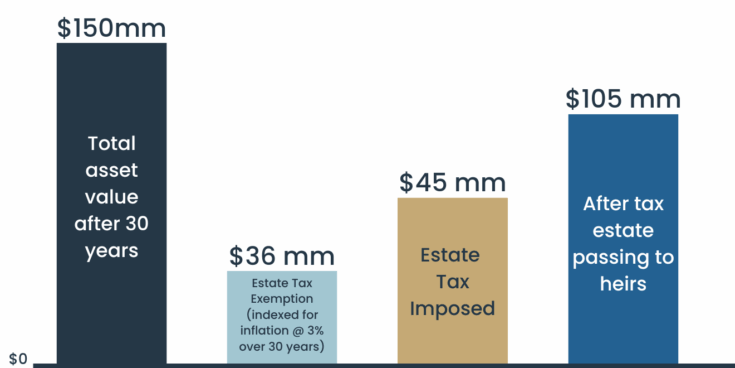
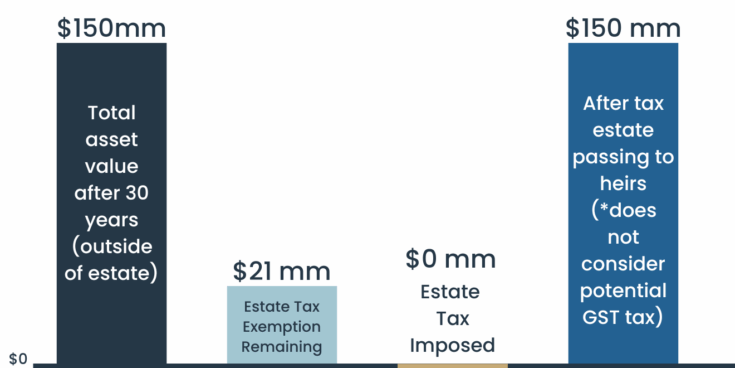
The charts below illustrate how gifting assets today can leverage the growth outside of your estate compared to waiting, even with inflation-adjusted exemption increases.

Gift at Death
The chart below assumes that a $15 million asset in your estate appreciates at 8% each year for 30 years. If you pass this asset to your heirs when you die in 30 years, assuming an estate tax exemption at such time of $36 million ($15 million indexed for 3% inflation), then the net taxable estate of $114 million would be taxed at 40% for a total of $45 million and an after-tax estate of $105 million passing to your heirs.

Gift Now
If instead you gift that asset now into an irrevocable trust for your heirs, the asset with absorb your entire tax exemption of $15 million (in 2026), but will grow tax-free, saving $45 million in tax (with an estate tax exemption of $21mm remaining for other assets).

Summary: Action Items & Planning Recommendations

StrategyBrief Explanation
Evaluate Lifetime GiftingGift appreciated assets now to transfer future growth out of the estate.
Set Up or Review Trust StructuresUse trusts to lock in exemptions and manage assets for beneficiaries.
Maximize GST Exemption UseWithout portability, make strategic GST-exempt gifts for each spouse.
Reassess Estate Plan TimingEarlier gifts may offer more leverage than waiting years.
Update Estate DocumentsEnsure wills, trusts, and related documents reflect the new exemption levels. If prior planning has been done around older, lower exemption amounts, there are opportunities to bring assets back into the estate, which can minimize capital gains at death.

Conclusion & Call to Action

The OBBBA has transformed estate-planning rules for high-net-worth families—elevating exemptions, preserving tax-efficient wealth transfers, and granting long-term clarity. However, state taxes and fine-print limitations underscore the need for careful and nuanced planning. With enough time and planning, estate taxes can be greatly reduced or eliminated entirely, even for estates well in excess of the new permanent exemptions.


Tobey Blanton Forney is a member of Kean Miller’s Estate Planning, Trusts, Successions & Probate group and practices in the firm’s Houston office. Tobey advises clients on their personal wealth, family, and legacy, helping them to not only manage their assets, minimize taxes, and put the right documents in place, but to translate their success into a meaningful legacy.

Enforcing a Fed. R. Civ. P. 45 subpoena against an expert is not for the faint of heart. Rarely invoked and often resisted, issuing a Rule 45 subpoena against an expert is tough to enforce but when it works, it can unlock critical discovery. Courts are often reluctant to compel an expert to produce anything beyond the disclosures required under Fed. R. Civ. P. 26, but some courts allow discovery of information beyond what Rule 26 requires expert disclosures to produce.

Differences Between Discovery Devices for Parties and Witnesses

The Federal Rules of Civil Procedure distinguish between discovery devices available against parties and those against nonparty witnesses.

  • Fed. R. Civ. P. 34 governs requests for production of documents from parties involved in the litigation. Rule 34 includes a specific provision regarding nonparties and references the ability to use Rule 45 against a nonparty.
  • Fed. R. Civ. P. 45 utilizes the subpoena power of the federal courts and allows parties to compel nonparties, including third-party vendors, experts and non-party witnesses to attend and testify for depositions and to produce requested documents through a properly issued Rule 45 subpoena.[1]
  • Fed. R. Civ. P. 26 governs the scope of expert discovery and mandatory disclosures in federal litigation, including the automatic disclosure of expert information without the need of additional discovery requests from the opposing party.[2]

The 2013 updates to Rule 45 establish that a subpoena must issue from the court presiding over the litigation, meaning that no matter where the non-party witness lives, the Rule 45 subpoena needs to be issued from the court where litigation is pending.[3] Using a Rule 45 subpoena gives attorneys the power to reach out-of-state experts, but it also provides jurisdictional safeguards for those experts, imposing compliance and commanding production of documents within 100 miles of where the person resides, is employed, or regularly transacts business.[4] It imposes responsibility on the party issuing the Rule 45 subpoena to take reasonable steps to avoid undue burden or expense and allows the person served to issue written objections and a court to quash or modify the subpoena.[5] 

Once a timely objection is lodged, Rule 45 triggers the ability to enforce the subpoena through a Motion to Compel, where the issuing party can request the court for an order compelling production or inspection.[6] Where the Motion to Compel is filed is important as it should be filed in the federal court where that expert is located, even if it that expert resides out of state.[7] This can mean litigating the enforcement of the Rule 45 subpoena in a different state than where the subpoena is issued (where the underlying litigation is) and sometimes even securing pro-hac vice admission to do it.

When is Rule 45 Worth the Fight?

Experts are not completely insulated from the reach of a properly issued Rule 45 subpoena. Various federal courts have recognized that Rule 26 does not limit or prohibit a party from requesting additional written information from an opponent’s testifying expert witness.[8] Arguably, a properly issued Rule 45 subpoena falls within the broad scope of Rule 26. As the Advisory Committee Notes made clear to the 1993 amendments, Rule 26 expressly recognizes that the required disclosures do not shut the door on traditional discovery methods to obtain further information.[9]

Rule 26 sets the floor, not the ceiling for expert discovery, and when more is needed, traditional discovery tools like a Rule 45 subpoena can be used to break through. Used strategically, Rule 45 is not just worth the extra fight, it can be the game changer in the litigation.


Amanda Collura-Day and Shiena Marie Burke are members of Kean Miller’s Casualty and Mass Tort Litigation group, which manages litigation dockets and tries cases for some of the leading companies in the United States. The team defends clients locally, regionally, and nationally in a wide variety of claims involving wrongful death, bodily injury, industrial accidents, chemical release or exposure, products liability, medical malpractice, workers compensation, as well as breach of contract and business disputes.


[1] Allstar Electronics, Inc. v. Honeywell Int’l, Inc., 8:10-CV-1516-T-30TGW, 2011 WL 4908853, *1 (M.D. Fla. Oct. 13, 2011).

[2] Fed. R. Civ. P. 26(a)(2).

[3] Fed. R. Civ. P. 45(a)(2).

[4] Fed. R. Civ. P. 45(c)(1)(A).

[5] Fed. R. Civ. P. 45(d)(3)(A)-(C).

[6] Fed. R. Civ. P. 45(d)(2)(B)(i)-(ii).

[7] Fed. R. Civ. P. 45(d)(2)(B)(i)-(ii).

[8] See, e.g., All W. Pet Supply Co. v. Hill’s Pet Prods. Div., 152 F.R.D. 634, 639 (D.Kan. 1993) (“With regard to nonparties such as plaintiff’s expert witness, a request for documents may be made by subpoena duces tecum pursuant to Rule 45.”); United States v. Bazaarvoice, Inc, No. C 13-00133 WHO (LB), 2013 WL 3784240, at *3 (N.D. Cal. July 18, 2013) (“Regardless of Bazaarvoice’s obligations under Rule 26(a)(2)(B), the government can use different discovery tools to illuminate and challenge expert testimony, as discussed above. A Rule 45 subpoena is such a mechanism.”); Roman v. City of Chicago, No. 20 C 1717, 2023 WL 121765, at *3 (N.D. Ill. Jan. 6, 2023); See Modjeska v. United Parcel Serv. Inc., 2014 WL 2807531, at *6 (E.D. Wis. June 19, 2014) (“Rule 26(a)(2)(B) governs only disclosure in expert reports, however, and it does not preclude parties from obtaining further information through ordinary discovery tools.”); see also Est. of Jackson v. Billingslea, 2019 WL 2743750, at *4 (E.D. Mich. July 1, 2019) (“[C]ourts routinely allow discovery of information beyond what 26(a)(2)(B) requires.”); Izzo v. Wal-Mart Stores, Inc., 2016 WL 593532, at *2 (D. Nev. Feb. 11, 2016) (“[W]here a party seeks addition [sic] information regarding the expert’s opinion, she may seek to obtain that information through the discovery process.”).

[9] Fed. R. Civ. P. 26(a)(2)(B) advisory committee’s note (1993 amendments).

The Collateral Source Rule is a common issue in almost every personal injury case, but its application can vary significantly from state-to-state. At its core, the rule is intended to ensure that the party responsible for the harm (the tortfeasor) is held fully accountable for the injuries they caused – and that they do not benefit from the plaintiff’s decision to obtain insurance or other benefits. While both Texas and Louisiana recognize the collateral source rule, they apply it with notable differences, particularly concerning statutory exceptions and its impact on medical damages.

Louisiana – Collateral Source Rule

For the longest time, Louisiana’s approach to the collateral source rule was considered one of the “stricter” collateral source states by comparison to other states. In recent years, there has been extensive change to the collateral source rule in Louisiana – through both the courts and the legislature.

  • General Rule Louisiana courts consistently hold that a defendant is not entitled to any credit for payments the plaintiff received from a collateral source. This includes insurance, social security, workers’ compensation, or even charitable donations.
  • Medical Expense Exceptions While Louisiana does not have the “Paid or Incurred” rule that Texas has, there are a few exceptions to the collateral source rule’s application dependent upon the source of the medical expense payments. In the last 20 years, the Louisiana Supreme Court has addressed whether medical expenses or rates set by Medicaid, the Workers’ Compensation Medical Reimbursement Fee Schedule, or by an agreement negotiated between the plaintiff’s lawyer and plaintiff’s doctor should be subject to the collateral source rule. However, it was not until recent years that the Louisiana legislature addressed these issues with the enactment of various versions of La. R.S. 9:2800.27.
    • No “Paid or Incurred” Limitation: Unlike Texas, Louisiana law does not always limit a plaintiff’s recovery to the amount actually paid by insurance in every situation.
    • Medicaid Payments: The collateral source rule does not apply to medical expense write-offs from Medicaid. Plaintiff’s recovery for medical expenses paid by Medicaid should be limited to the amount Medicaid actually paid to the healthcare provider. Medicaid is a form of free medical service. Applying the collateral source rule to these payments would allow the plaintiff to recover the written-off amount and “pocket the windfall” of charges plaintiff was never obligated to pay. This is codified in La. R.S. 9:2800.27(C).
    • Workers’ Compensation Medical Payments: The collateral source rule does not apply to amounts that were written off pursuant to the Louisiana Workers’ Compensation Medical Reimbursement Fee Schedule – a statutory list of charges for medical treatment, typically less than charges made outside of the workers’ compensation system. (Note: This Fee Schedule is currently undergoing a legislative update). Again, because these charges are statutorily set, the plaintiff would never be obligated to pay the full charges. This is codified in La. R.S. 9:2800.27(D).
    • Attorney Negotiated Reduced Rates: In many cases, the plaintiff’s lawyer has a relationship with the plaintiff’s doctor and as a result of that relationship the doctor may agree to accept a lower amount for the medical services than what the doctor actually bills. When this happens, the collateral source rule does not apply to these medical expense write-offs resulting from attorney’s negotiation. The plaintiff’s recovery should be limited to what was actually paid to the medical provider. This is in La. R.S. 9:2800.27(G).
    • Medicare and Health Insurance Payments: In cases where the medical expenses have been paid, in whole or partially, by a health insurer or Medicare to a healthcare provider, the recovery of those medical expenses should be limited to the amount actually paid, plus any applicable cost sharing amounts paid or owed by the claimant – not the full amount billed. The phrase “cost sharing” is defined in the new 2025 legislation as, any “copayments, coinsurance, deductibles, and any other amounts which have been paid or are owed by the claimant to a medical provider.”
    • Louisiana Civil Justice Reform Act: Originally passed in 2020, this legislation was amended again in 2025, addressing the collateral source rule and recovery of past medical expenses. Due to the infancy of this act, time will tell how it impacts medical expense in personal injury litigation recovery moving forward. The full, current version can be found here – La. R.S. 9:2800.27.
  • Impact on Evidence at Trial – The factfinder should be informed of both the amount billed by the medical provider and the amount actually paid for the medical services. This is a fairly new change in the law, as the jury was previously only told of the amount billed – not what was paid.

Texas – Collateral Source Rule

In Texas, the collateral source rule is well-established and frequently applied in personal injury litigation. However, several key exceptions can significantly impact how medical expenses are calculated and what the plaintiff may ultimately recover from the tortfeasor.

  • General Rule – The rule generally prohibits the defendant from introducing evidence that the plaintiff’s medical bills were paid by a third party (i.e., health insurer, workers’ compensation carrier, etc.). The rationale behind this rule is that the wrongdoer should not benefit from the victim’s foresight in securing their own insurance.
  • Medical Expense Exception – Texas law does not allow a plaintiff to recover more than the amount actually paid for medical expenses by an insurance provider. This principle is commonly known as the “Paid or Incurred” rule and is codified in Texas Civil Practice and Remedies Code § 41.0105. The Texas Supreme Court has explained that if a plaintiff’s insurer has negotiated a lower rate and the healthcare provider accepts that reduced rate as payment in full, the plaintiff can only recover the lower rate. The difference between the billed amount and the paid amount is considered a “phantom damage” because the plaintiff was never responsible for it. This is a significant limitation on the collateral source rule, when applied and argued correctly.
  • Other Notable Exceptions
    • Tortfeasor’s Insurance: In cases where the alleged tortfeasor’s own insurance company has paid the plaintiff’s expenses, the collateral source rule should not apply to those payments, and those payments should be deducted from the damages ultimately owed.
    • Subrogation: The collateral source rule does not impact or eliminate an insurer’s right of subrogation. If an insurer has paid the plaintiff’s expenses, it may still seek reimbursement for those expenses from the tortfeasor or from the plaintiff’s recovery.
    • Impeachment Evidence: In limited instances, evidence of collateral source payments may be admissible to impeach a witness, though such situations are rare and depend entirely on the witness’s testimony.
  • Impact on Evidence at Trial Typically, the jury is not informed of the source of the payment (i.e., insurance). Rather, the jury is shown only the amount paid. This rule can cut both ways – as it prevents the jury from seeing the full, billed amount of the medical expenses, and also prevents evidence of the amounts written off due to negotiated discounts (i.e., the “phantom damages”).

Examples of Using These Tools to Reduce Damages

Kean Miller’s team has repeatedly used the above law and arguments to successfully reduce our client’s exposure prior to trial.  Below are a few examples of Kean Miller’s team reducing the plaintiff’s claimed medical special damages (what was charged) to the amount actually paid.

  • From $345,233 to $79,854 – Reduction based on workers’ compensation payments. Products liability claim, amputated leg.
  • From $311,684 to $83,542 – Reduction based on Medicaid payments and attorney negotiated write-offs. Automobile accident, neck and lower back injuries.
  • From $278,457 to $104,652 – Reduction based on workers’ compensation payments and attorney negotiated write-offs. Industrial accident at petrochemical facility, head trauma and spinal injuries.
  • From $153,468 to $86,342 – Reduction based on workers’ compensation payments. Industrial accident at natural gas storage and processing facility.
  • From $106,789 to $22,861 – Reduction based on workers’ compensation payments and attorney negotiated write-offs. Automobile accident, neck and lower back injuries.

Takeaway

Despite being neighboring states, Texas and Louisiana’s application of the collateral source rule can differ significantly. If you or your company are found defending a personal injury matter in either state, understanding the distinction in each state’s application of the collateral source rule is crucial to accurately evaluate potential damages, implement a defense to minimize tort exposure, and strategize a defense.


Forrest Guedry and John Hogg are members of Kean Miller’s Casualty and Mass Tort Litigation group, which manages litigation dockets and tries cases for some of the leading companies in the United States. The team defends clients locally, regionally, and nationally in a wide variety of claims involving wrongful death, bodily injury, industrial accidents, chemical release or exposure, products liability, medical malpractice, workers compensation, as well as breach of contract and business disputes.